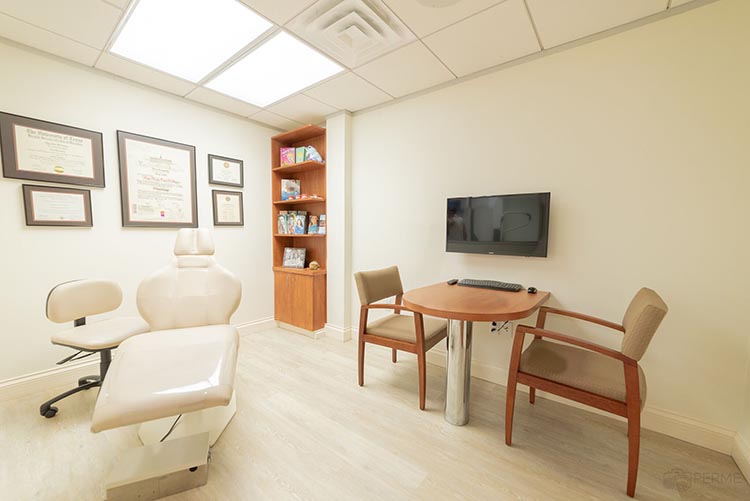
Dr. Salas presents every option — and recommends only what you need.
West U Orthodontics is not a high-volume factory. Dr. Salas spends real time at your consultation understanding your case, your preferences, and your life — and then recommends the treatment that actually fits.
Metal braces
The gold standard for power and versatility. Today's metal brackets are smaller, smoother, and far more comfortable than what most adults remember. Metal braces work best for complex crowding, severe bite correction, and younger patients who need the most precise control over tooth movement.
- Most effective option for complex rotations and bite correction
- Works in all patients regardless of bite complexity
- Fastest treatment times in many cases
- Reliable — no risk of aligner non-compliance
- Covered by most orthodontic insurance plans
Clear ceramic braces
Tooth-colored brackets that provide the same clinical results as metal braces — with a far less visible profile. Popular with teens who are socially conscious and adults who want effective treatment without the metallic look.
- Same precision and control as metal brackets
- Blend with natural tooth color
- Ideal for front teeth — less visible in photos and conversation
- Slightly larger than metal — Dr. Salas will advise per your case
Empower® self-ligating braces
Dr. Salas is experienced with Empower® self-ligating brackets — a system that eliminates the elastic ties traditional braces use, replacing them with a built-in clip mechanism. This reduces friction along the wire and often means fewer and shorter adjustment appointments.
- No elastic ligatures — lower friction, more consistent forces
- Often fewer adjustment visits required
- Easier to clean around brackets
- Available in metal and clear versions

Invisalign® clear aligners
Custom-fabricated clear aligner trays that move teeth gradually and discreetly. Each tray is worn for 1–2 weeks, then swapped for the next in the series. Invisalign is removable for eating, brushing, and special occasions — and virtually invisible in professional and social settings.
- Near-invisible — nobody knows you are in treatment
- Removable for meals, brushing, and events
- Comfortable smooth plastic — no wires to poke
- Effective for mild to moderate crowding, spacing, and many bite issues
- Covered by most orthodontic insurance plans that cover braces
Invisalign Teen®
Designed specifically for teenage patients — with compliance indicators (blue dots that fade as the aligner is worn), extra replacement aligners for inevitable losses, and accommodations for teeth that are still erupting. All the discretion of adult Invisalign; engineered for teenage reality.
- Compliance indicators make monitoring easy
- Accommodates still-erupting permanent teeth
- Includes 6 free replacement aligners
- No brackets to pop off before school photos
Two-phase & early interceptive treatment
The AAO recommends that all children have an orthodontic evaluation by age 7. Most will not need early treatment — but Dr. Salas can spot developing problems with jaw growth, tooth eruption, or bite patterns that are much easier to correct while the bones are still forming. Early intervention can reduce or eliminate the need for more complex treatment later.
- Phase 1: jaw and space management (ages 7–10)
- Palatal expanders for narrow upper arches
- Space maintainers for early tooth loss
- Phase 2: full alignment after permanent teeth erupt
- Complimentary first evaluation for children

Surgical orthodontics & dentofacial orthopedics
Some bite problems involve the jaw bones themselves — not just the teeth. When the upper and lower jaws do not align correctly at a skeletal level, Dr. Salas coordinates with oral and maxillofacial surgeons to achieve results that braces or aligners alone cannot. This is called orthognathic surgery, and Dr. Salas manages all orthodontic phases of the treatment arc.
- For severe underbites, overbites, or open bites with skeletal cause
- Pre- and post-surgical orthodontics managed by Dr. Salas
- Coordinated with trusted Houston oral surgery practices
- CBCT cone beam imaging used for precise surgical planning